![[personal profile]](https://www.dreamwidth.org/img/silk/identity/user.png)

This series is an exploration of the works of Tristan Gooley. I’ll document my efforts to learn to read nature’s signs. If you enjoy reading, I encourage you to support the author by purchasing a copy of Wild Sings and Star Paths (UK) or The Nature Instinct (US). I’m in no way affiliated with the author, nor do I profit from sales of the book.
Last Week’s Work
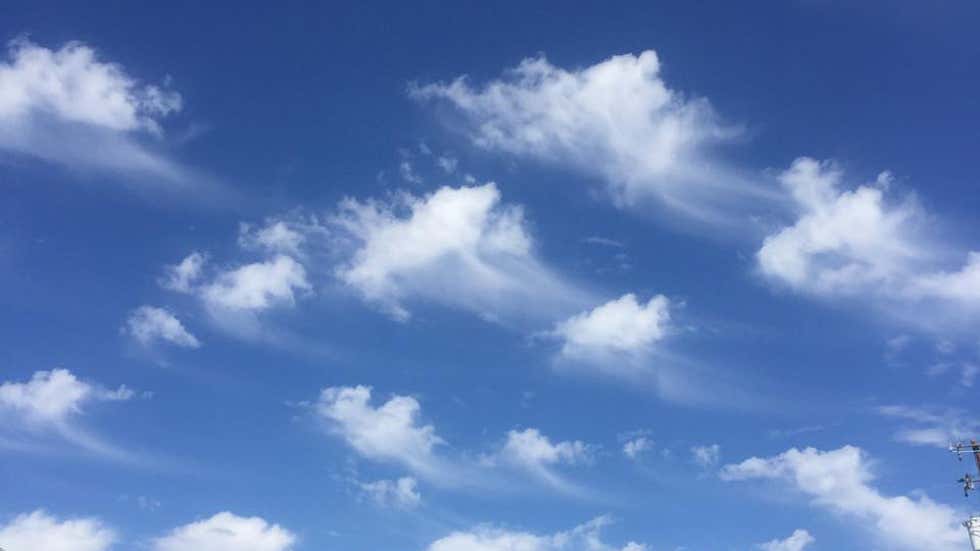
To observe the shear—the effect in which the tops of clouds are pushed farther over and ahead by the wind, revealing direction
New World
I had ample opportunity to spot this sign over the past couple of weeks. It’s very straightforward, but not as easy at it sounds. In practice, many times I could see wisps trailing across the sky, but it took some time to figure out which was the head and which was the tail. The shear seems to work best with cumulus clouds. The stratus variety is fine as long as there’s blue sky to contrast it with, but that isn’t always the case. It was helpful to think of the cloud mass as a big pile up. The wind aggregates water particles in a big lump, and only some of those particles near the top and the front get pushed ahead at a higher speed.
That means we can eliminate two directions right away. If the clouds press into a line that is long in width and short in depth, the wind is probably coming from one of the two long sides, not the short ends. Imagine a rectangle, four units on two sides, and one unit on the others. The wind comes from one of the four unit sides. This same principle can be seen in sand dunes, sastrugi, etc. The reason is a pile-up effect. Then, we just need to see which of those sides is falling over itself to get ahead.
Annoyingly, not every cloud cooperates so neatly. It’s better to take a broad sample than base direction on a single character. In the first image, the clouds are moving from left to right and a little away from us (I think!), but it isn’t always obvious. Notice how the tops of some seem to jog ahead of the base. In the second, we get a curveball from low cirrus clouds. Cirrus is made of ice particles, the heavier of which fall out of the main body and are blown ahead. That means the shear is inverted, coming from the bottom. Gooley says it gets easier to spot in a moment the more you practice, and I’ve felt the ease increase.

Now I’ll get speculative. These essays run the risk of being little more than “Here’s the sign, I saw it, or I didn’t.” That’s fine. This is more of a journal of my study than new information. I don’t know enough to teach anything. But it occurred to me early on that a lot of these signs work as personal and social metaphors, so for my own amusement, I’ll explore that thread when it feels appropriate.
We can think of clouds as mass movements. This can be an organization, a trend, or any other collective where people get piled together by some common force. The shear, then, corresponds to those leading edges that rush ahead of the movement. We can learn about the force that generates these movements—where it comes from, how powerful it is, and where it’s headed—by observing the shear. That doesn’t just mean any of the edges and outliers. As we saw in the pictures, those can take many shapes and give conflicting impressions.
How does a mass movement change those who lead it? Those followers who are most eager and active in their participation? The members who are quick to progress? Their actions will tell us something of the nature of the force that moves these people. Remember that the more consistent examples we have, the more reliable they are. If a lot of the key figures in a movement seem to be kind, generous, and acting to help others, that says something of the driving force, even if the mass has yet to reach their standard. If they seem to be getting crazier and more erratic, we might choose to avoid that movement. These are the bellwethers. All the more reason to sit back, observe, an make sure to always check your results against future observances before diving headfirst into something. The winds are always shifting.
Key #8: The Ramp
We can observe the same effect of the shear in the shape of trees, sand dunes, ice, sediment, and anything else the wind is strong enough to affect. It creates what looks like a ramp: shallow and gentler on the windward side, tall and with a steep drop off on the leeward side. Unlike clouds, some of these things last for days, months, or longer than a human lifetime. This both gives us direction, and the origin of the prevailing wind.


no subject
Date: 2021-11-04 05:43 pm (UTC)Are there indicators when there might be contrary winds, going in different directions (if that's even a thing)?
no subject
Date: 2021-11-04 10:32 pm (UTC)But winds can definitely go different directions at the same time, for example, at the ground, the low atmosphere, and the upper. So you could have the trees blowing one way, the cumulus clouds another, and the cirrus clouds a third. That would tell you to expect some very interesting and unsettled weather shortly.